


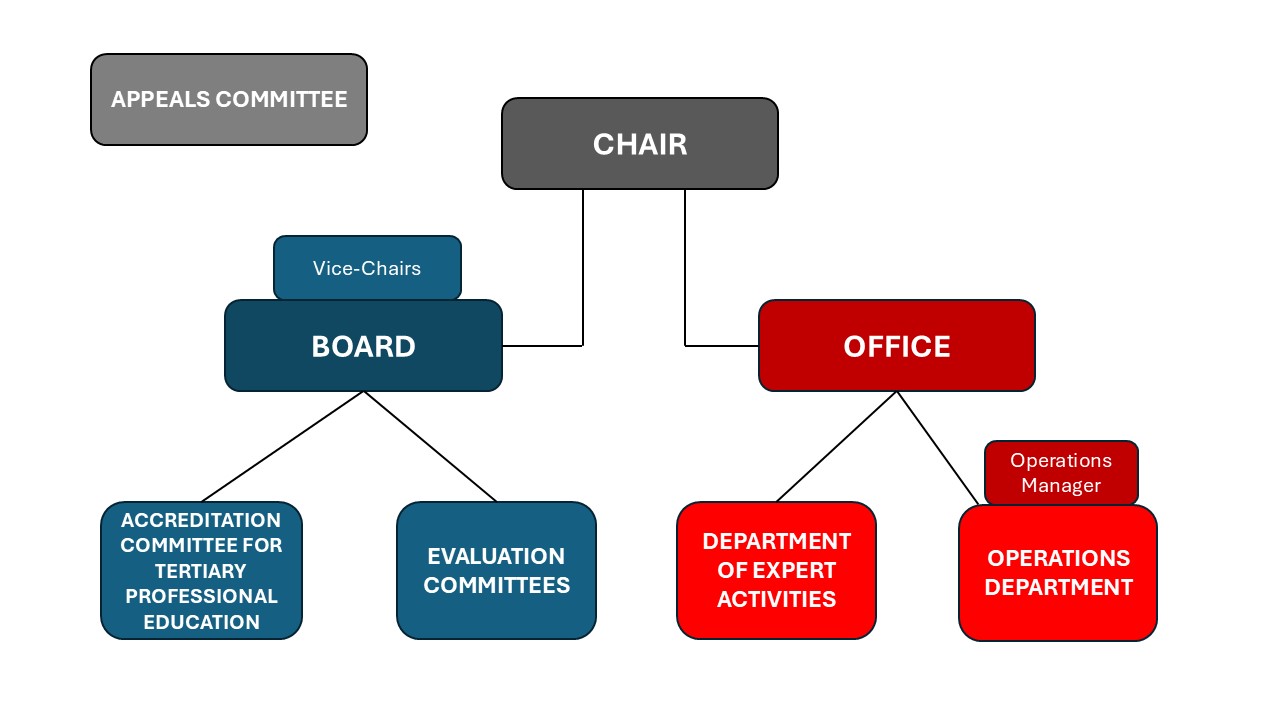
NAB Bodies:
- NAB Board: The Board is an executive body whose 15 members are appointed by the government. These members are independent experts from higher education and other relevant sectors. The Board decides on accreditations within administrative proceedings, issues opinions and determines the methodology of quality assessment of higher education institutions, tertiary professional schools, study programs and educational programs.
- NAB Appeals Committee: The Appeals Committee has 5 members and decides on appeals against the Board’s decisions in administrative proceedings (i.e. accreditation procedures) in cases specified by law. The members of the Appeals Committee are appointed by the government from among individuals with a university degree in law.
-
Accreditation Committee for Tertiary Professional Education: The Accreditation Committee for Tertiary Professional Education is a specialized advisory body that engages in the assessment of applications for the accreditation of educational programs at tertiary professional schools. It prepares supporting materials and opinions for the NAB Board’s decision-making on matters of tertiary professional education. Its composition, scope of authority, and activities are governed by legal regulations and the NAB’s internal regulations.
- Evaluation Committees and Pool of Evaluators: Evaluation committees are advisory bodies to the Board. They perform peer review in administrative proceedings regarding accreditation, external evaluation, and proceedings in matters of state approval and domestic approval and authorization. Members of the evaluation committees are selected from experts enrolled in the Pool of Evaluators. The establishment, composition, and activities of the committees are governed by NAB’s internal regulations.
- NAB Office: The NAB Office provides administrative, organizational, and specialized support for NAB’s activities. The staff contribute to the preparation of materials for the Board’s decision-making, coordinate the activities of NAB’s advisory bodies, and facilitate communication with higher education institutions, tertiary professional schools and the public.